

Elder Tree Research Notes
Spring elderflower bonanza is a time to celebrate

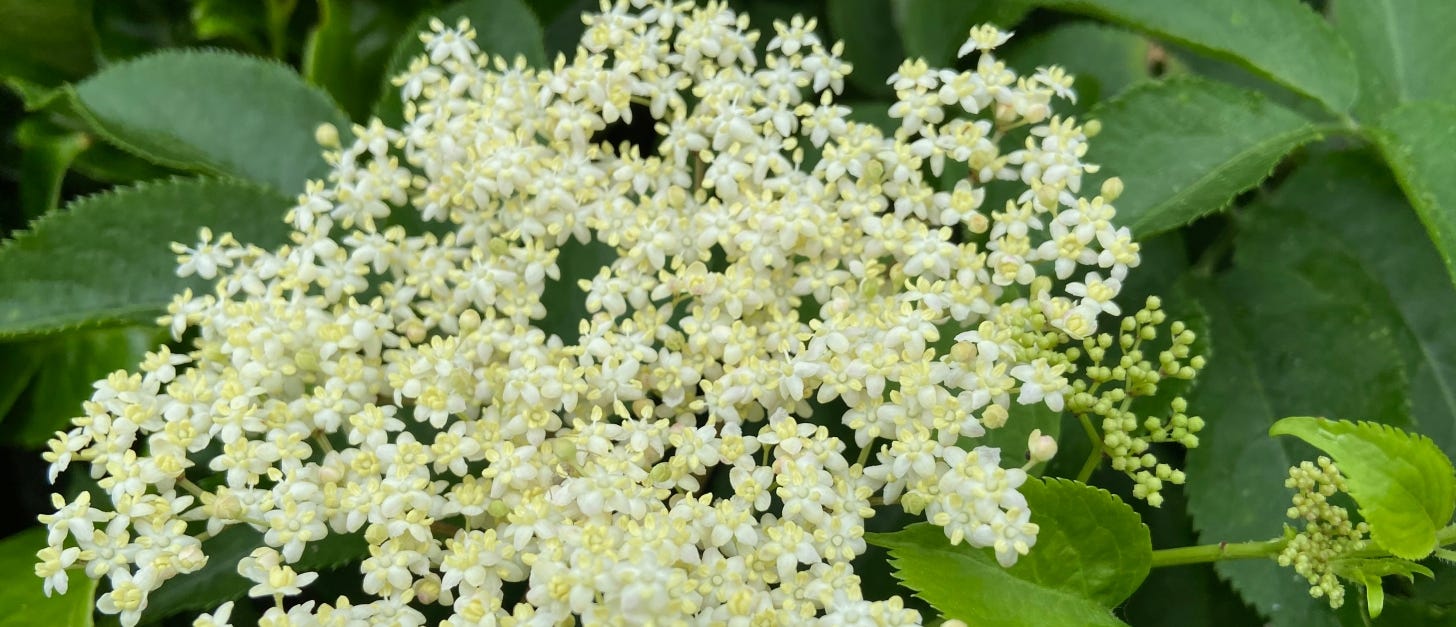
The elder (Sambucus nigra) is widespread in fields, hedgerows, waste places and woodland edges with flat white heads of elder flowers appearing everywhere. The elder has many traditional uses and today is particularly noted for reducing symptoms in colds and influenza. The flowers are a perennial crop with potential for agroforestry systems. And the flowers are not the only crop because where they are not harvested the trees will go on to ripen panicles of berries towards the autumn. The flowers can be infused to make a tasty vinegar, see the recipe below.
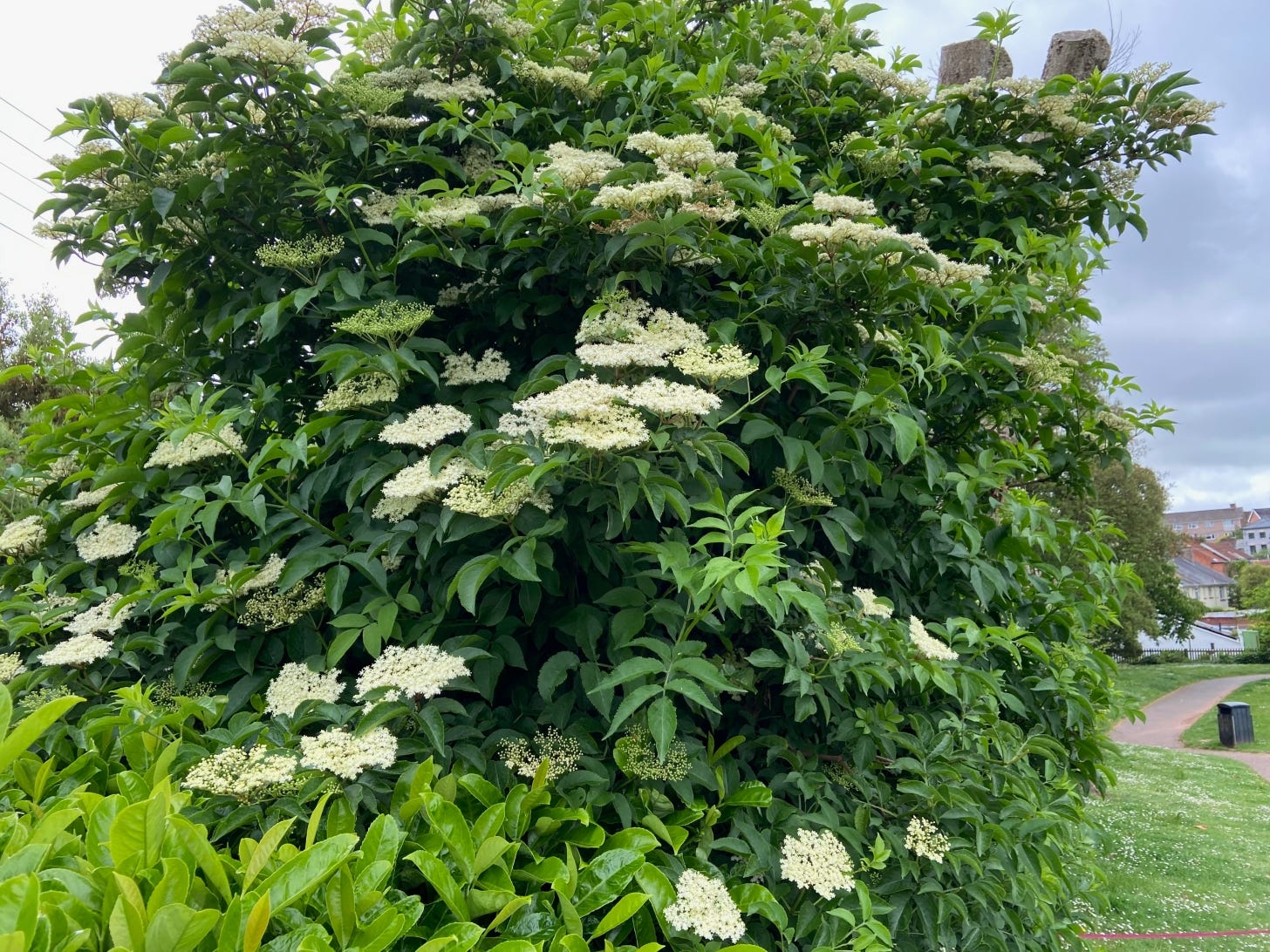
The European elder is a small tree in the honeysuckle family (previously the Caprifoliaceae and now called the Adoxaceae) with panicles of white flowers followed by blue-black berries. It is a fast-growing shrub and can reach 6 m tall and almost as wide. Native to Europe, northern Africa, and western and central Asia, it is found in moist places for preference. Red elder (S. racemosa) and American elder (S. canadensis) are North American species, the latter often planted in Europe for flower and fruit production. The plants are sometimes wild harvested or if cultivated then they can be cut back to the ground to form branching canes.
Medicinal uses of elder flowers and fruits
Elder flowers are anti-inflammatory, diaphoretic, diuretic, expectorant, antioxidant, anticatarrhal, antibacterial, antiviral and laxative. The flowers contain flavonoids (kaempferol, astragalin, quercetin, rutin, isoquercitrin, hyperoside), as well as triterpenes, sterols, phenolic acids and glycosides. The flowers can be used as a diaphoretic for fever and chills, for symptomatic treatment of the common cold and as an expectorant for inflammation of the upper respiratory tract. Elder fruits contain flavonoid glycosides (hyperoside, isoquercitrin, rutin) and anthocyanin glycosides (chrysanthemin, sambucin, sambucyanain). Elder berry syrup is popular for treating colds and influenza, leading to a reduction in upper respiratory symptoms (Wieland et al., 2021). One study showed that elderberry extract significantly reduced duration and severity of cold symptoms in air travellers (Tiralongo et al., 2016). Antiviral properties have been shown for elder extracts to help in respiratory complaints though more research is needed (Setz et al., 2023).
Growing and coppicing for medicinal use


Elder is hardy and will grow in most soils, even very chalky sites, and can tolerate atmospheric pollution. It does prefer moist soil and can be damaged by extensive drought so this should be minimised with mulching. The elder is vigorous and can grow fast. It does well in an open position or along a woodland edge, though fruiting can be poor in shade. There are cultivars available that produce medium to large clusters of fruit, and some that are richer in anthocyanins. A range of approaches to cultivation are possible. In a forest garden the elder can be coppiced or pollarded. If it is cut back to just above ground level on a three-year cycle then fruit will be produced in the second and third years.
Harvesting and use of elder flowers and berries


Flowers are harvested when open and can be removed from the stalks with a fork. They can be used fresh or dried for later use in infusions. The fruit is harvested when ripe and can be used straight away or dried for later use. If the fruit is frozen then it will readily fall off the stalks. As much as 3 kg or more of fruit per established bush may be harvested, depending on the cultivar. The fruits should always be cooked before use. Do not harvest bark, leaves or stems as toxic alkaloids and cyanogenic glycosides are mainly found in these parts. Although there is safe and longstanding use of elder in many cultures, it is advised to avoid elder preparations in pregnancy or breastfeeding.
Elderflowers can be used fresh in infusion, 1 teaspoon to a cup up to three times per day for respiratory complaints and hay fever. Elderberry tincture is taken from 5-25 ml per day. Elderberries can be made into a syrup, used at 2 teaspoons up to 4 times daily.


Recipe for Elderflower Vinegar
10 fresh elderflower heads
500 ml wine or apple cider vinegar
2-3 strips lemon peel (optional)
200 g sugar
Harvest ripe elderflower heads with flowers fully open, do not use if they are beginning to brown. Do not wash the flowerheads but shake well and check that there are no insects. Remove the flowers from the stems and place them in a glass jar and press down gently. Add 2-3 strips of lemon peel for flavour. Cover with the vinegar, making sure all flowers are below the surface. To keep the flowers below the surface you can use a glass weight or a small plastic bag filled with water. Cover the jar and leave for two weeks occasionally shaking. Then strain off the liquid and add to a saucepan with the sugar. Bring to the boil stirring until the sugar is dissolved. Allow to cool and then store in labelled bottles. For marinades and salad dressing, dilute with sparkling water, or use in a cocktail!
You can see more recipes for elderflowers from Stephanie Hafferty at Permaculture Magazine, here…
Potential for growers
A study in the USA in 2020, found that elder berry was the top-selling herbal dietary supplement ingredient in mainstream retail outlets. Consumers spent an estimated $275 million on elder berry supplements through these outlets in 2020, an increase of over 150% from 2019. A major trade source for elder products are fruits ‘collected in the wild populations of many areas of Europe, mainly Balkans, Poland and Russia’ (Smith et al., 2021). The use of elder berries has rapidly increased with interest in commercial products for medicinal effects to benefit the respiratory system. Preparations of elderberry extracts such as Sambucol are widely sold over the counter for relief of flu symptoms. Interest in drinks based on elder flowers and berries has grown. A number of UK growers have established good-sized plantations of elder, such as Bushbarn Farm in East Sussex. They have 25 acres of organically grown elder trees and sell award winning cordials online, also supplying fresh flowers and juice, frozen or dried berries. And Belvoir Farm, a certified B corporation, have 60 acres of elder trees and sell sparkling elderflower drinks.
Practicalities of cultivating elder
Cultivation in Europe within agroforestry systems has been reviewed by the AFINET project and pros and cons considered (Romero-Franco et al., 2018). In Europe the Polyculture Project in the Balkans have elder plants available at 9 euros, details here. In the UK, a Nuffield-supported research study focused on elder flowers and offered some conclusions about the importance of quality and partnerships for a developing marketplace (Jones, 2020).
Elder is gratifyingly quick to reach full yielding stage, enviably long in its productive longevity and a UK native producing two usable crops - flowers and berries, both as positive for our health as they are delicious - ingredients that lend themselves to a multitude of market places, some of which already exist and others that are yet to be developed. (Jones, 2020, p.45).
Celebrate this bonanza
Elder is a generous plant in giving us both flowers and fruit beneficial for human health. There is potential in agroforestry projects for supplying the high demand for elder products. The elder has further uses such as offering nesting sites for birds, and it can be used as hedging. Fortunately, the elder is so widespread that we can celebrate and harvest the flowers now. Make sure you note the location of elder trees as they will be bearing fruit in the autumn (so long as you do not remove all of the flowers!).
References
Jones A. 2020. Cultivating elders for the UK processing industries. Nuffield International Farming Scholars Report. Accessed 13 May at
https://www.nuffieldscholar.org/sites/default/files/reports/2019_UK_Alice-Jones_Cultivating-Elders-For-The-Uk-Processing-Industries.pdf
Romero-Franco RA, Rigueiro-Rodríguez N, Ferreiro-Domìnguez MP, et al. 2018. Production of medicinal and culinary plants in agroforestry systems: Sambucus nigra L. AFINET Factsheet. Accessed 13 May 2026 at https://euraf.isa.utl.pt/files/pub/20190615_factsheet_23_en_web.pdf
Setz C, Fröba M, Große M, et al. 2023. European black elderberry fruit extract inhibits replication of SARS-CoV-2 in vitro. Nutraceuticals 3: 91–106. doi: 10.3390/nutraceuticals3010007. doi.org/10.3390/nutraceuticals3010007
Smith T, Eckl V, and Reynolds CM. 2021. Herbal supplement sales in US increase by record-breaking 17.3% in 2020: Sales of immune health, stress relief, and heart health supplements grow during COVID-19 pandemic. HerbalGram 131: 52–65. https://www.herbalgram.org/resources/herbalgram/issues/131/table-of-contents/hg131-mkrpt/
Tiralongo E, Wee S and Lea R. 2016. Elderberry supplementation reduces cold duration and symptoms in air-travellers: A randomized, double-blind placebo-controlled clinical trial. Nutrients 8: 182. doi: 10.3390/nu8040182
Wieland LS, Piechotta V, Feinberg T, et al. 2021. Elderberry for prevention and treatment of viral respiratory illnesses: A systematic review. BMC Complementary Medicine and Therapies 21: 112. doi: 10.1186/s12906-021-03283-5